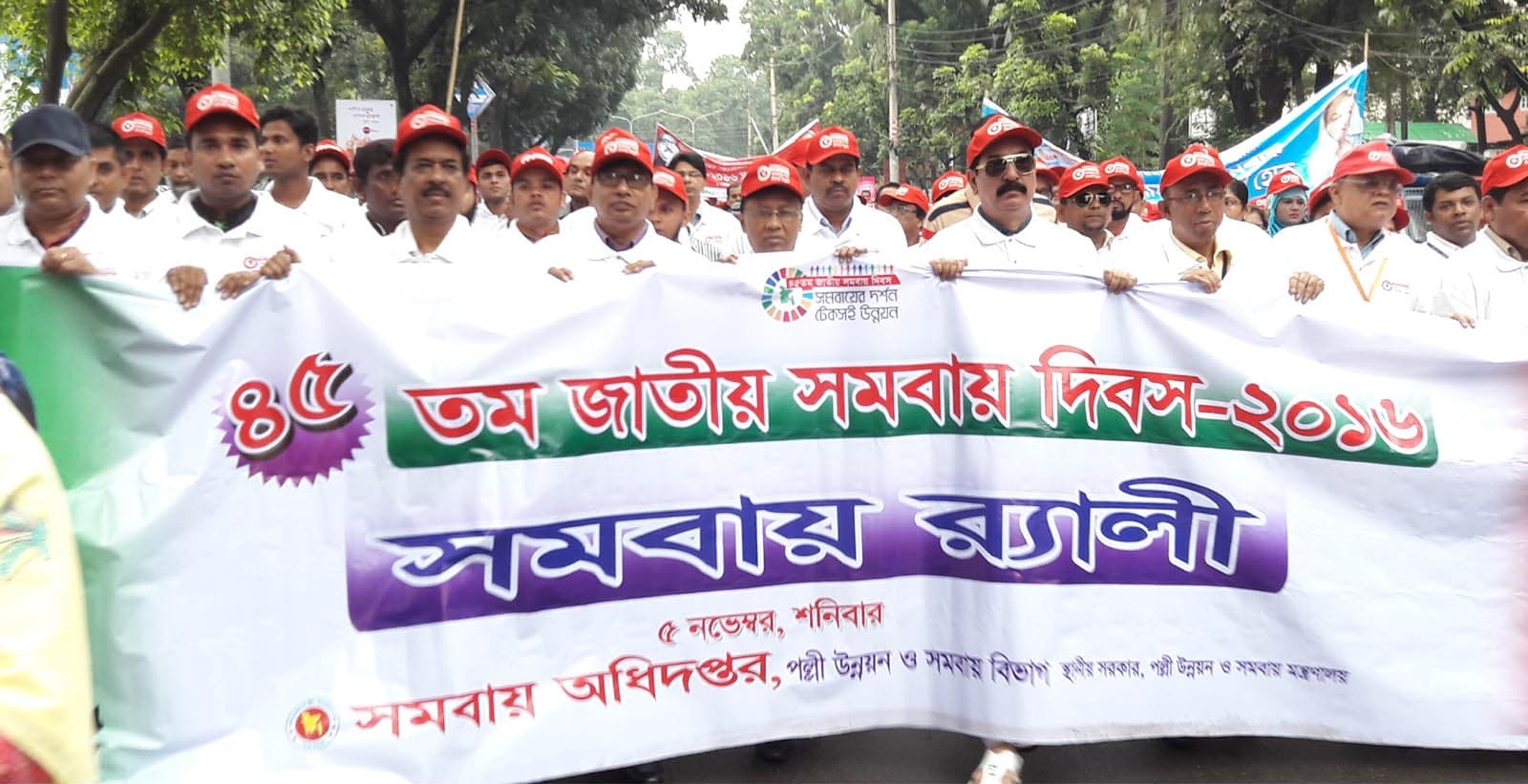
Bangladesh has over 200,000 cooperative societies with approximately 10 million members, making cooperatives a significant part of rural economic life since the 1960s — and the Comilla Model, developed at Kotbari, remains one of the most influential rural cooperative experiments in development history.
Bangladesh Cooperatives at a Glance
| Indicator | Figure |
|---|---|
| Registered cooperative societies | 200,000+ |
| Total members | ~10 million |
| Primary law | Cooperative Societies Act 2001 |
| Regulator | Registrar of Cooperative Societies, Ministry of Local Government |
| Apex cooperative bank | Samabay Bank |
| Most cited model | Comilla Model (1960) |
| Largest dairy cooperative | Milk Vita (100,000+ farmer members) |
| Grameen Bank borrowers | 9 million+ (cooperative-adjacent model) |
History: The Comilla Model That Changed Global Cooperative Theory
Akhter Hameed Khan and the Comilla Experiment (1960)
The most important moment in Bangladesh's cooperative history began not in a ministry but in a village near Comilla (now Cumilla), in what was then East Pakistan. In 1959, Akhter Hameed Khan — a civil servant turned development thinker — became director of the Pakistan Academy for Rural Development at Kotbari, Comilla.
Khan was skeptical of the standard government-led cooperative model, which required farmers to join large, unwieldy societies managed by extension officers. Instead, he designed what became known as the Comilla Model: a two-tier cooperative system built around small village-level primary societies (15–20 farmer households) that fed into a central cooperative union at the thana (sub-district) level.
The two-tier structure solved a persistent problem in cooperative design: primary cooperatives were small enough for members to know each other and enforce repayment, while the central thana union was large enough to access institutional credit, run training programs, and coordinate input supply.
The model included several interconnected elements:
- Weekly meetings at primary society level — combining savings deposits, loan repayment, and farmer training
- Supervised credit tied to specific agricultural inputs (seeds, fertilizer, irrigation)
- Irrigation cooperative systems — pooling investment in low-lift pumps and tube wells that individual farmers could not afford
- Women's cooperatives running parallel to men's societies from the outset
By 1970, the Comilla Model had reached 350+ primary cooperatives and become the basis for the government's national cooperative expansion program across East Pakistan. After independence in 1971, the new Bangladeshi government adopted the model as the foundation of rural cooperative policy.
BRDB Establishment and Post-Independence Scale-Up
The Bangladesh Rural Development Board (BRDB) was established in 1972 as the institutional vehicle for scaling the Comilla Model nationally. BRDB's mandate was to organize smallholder farmers into primary cooperative societies (KSS — Krishi Samabay Samiti) at village level and central cooperative societies (BSCIC) at thana level, providing agricultural credit, inputs, and technical services.
By the 1980s, BRDB had enrolled millions of rural households into cooperative societies. The reach was real, but the quality was uneven: externally-organized cooperatives without genuine member buy-in were, predictably, less durable than those where farmers had self-organized.
The Cooperative Societies Ordinance of 1984 further extended the framework, creating explicit categories for different cooperative types and strengthening the Registrar's authority. The current Cooperative Societies Act 2001 replaced this ordinance and remains the primary legislation.
Regulatory Framework: The Registrar of Cooperative Societies
All cooperative societies in Bangladesh register under the Cooperative Societies Act 2001 with the Registrar of Cooperative Societies, who operates under the Ministry of Local Government, Rural Development and Cooperatives.
The Registrar has authority to:
- Register and de-register cooperative societies
- Audit cooperative accounts (or direct external auditors to do so)
- Settle disputes between cooperative members and management
- Approve amendments to cooperative bylaws
- Appoint administrators to societies in governance crisis
Bangladesh's cooperatives span multiple levels:
- Primary cooperative societies — village or community level
- Central cooperative societies — thana/upazila level, federating primaries
- National apex bodies — federating central societies in each sector
The Samabay Bank (cooperative bank) sits at the apex of the financial cooperative system, providing banking services to cooperative societies and their members.
BRDB Cooperatives: The Rural Credit and Input System
BRDB's cooperative network remains the largest formal cooperative structure in Bangladesh. BRDB-organized primary societies — KSS (Krishi Samabay Samiti) for men and BSSS (Bhumi Shramik Samabay Samiti) for landless laborers — provide:
- Agricultural credit at below-market rates, linked to input purchase
- Collective input supply (seeds, fertilizer, pesticides) through thana-level central cooperatives
- Irrigation coordination — managing low-lift pump and tube well schemes collectively
- Savings discipline — compulsory weekly savings that build a member's equity stake
BRDB operates in all 64 districts of Bangladesh. Its coverage is vast but its performance metrics are mixed. Loan recovery rates have historically been below 80%, and the organization has faced criticism for bureaucratic management that undermines genuine member control — a structural tension in government-promoted cooperative systems.
Grameen Bank: Cooperative-Adjacent Microfinance
Grameen Bank is not technically a cooperative under Bangladesh's Cooperative Societies Act. But its operating model is functionally cooperative in most respects: it is borrower-owned (borrowers hold 90% of shares, government 10%), governed by a board where borrowers elect their representatives, and operates through village groups with collective social guarantees.
Founded by Muhammad Yunus in 1983 (formalized from earlier experiments begun in 1976 at Jobra village), Grameen has served over 9 million borrowers — 97% women — through approximately 900,000 village-level lending groups. Interest rates are around 20% declining, significantly below informal moneylender rates but higher than BRDB cooperative credit.
Grameen's village group model is directly descended from the Comilla Model's insight about small-group social accountability. Khan's two-tier structure at thana and village level, Yunus's five-member lending groups — both use peer accountability to solve the credit risk problem that prevents banks from lending to asset-poor farmers and women.
The Grameen model has been exported globally. The concept of group-based microcredit — sometimes called Grameen-style lending — has been adapted in 40+ countries, making Bangladesh's cooperative-adjacent experiments arguably the most globally influential rural finance innovation of the 20th century.
Milk Vita: Bangladesh's Dairy Cooperative
Milk Vita — formally the Bangladesh Milk Producers' Cooperative Union Limited — is the largest dairy cooperative in Bangladesh and one of the more successful cooperative enterprises in South Asia.
Established in 1973 and modeled partly on India's Operation Flood and AMUL structure, Milk Vita collects milk from smallholder dairy farmers organized into village-level milk collection cooperatives. Farmers deliver milk to collection points twice daily; Milk Vita chills, processes, and distributes dairy products — fresh milk, yogurt, ghee, butter — through a network covering Dhaka and major cities.
By 2023, Milk Vita had:
- 100,000+ farmer members across 3,000+ primary cooperatives
- Collection capacity of 400,000 litres per day
- Processing plants in Pabna (headquarters), Dhaka, and other districts
- A market share in Bangladesh's organized dairy sector exceeding 40%
Milk Vita's model directly addresses the smallholder dairy farmer's core problem: individual farmers with 1–2 cows cannot negotiate prices, access refrigeration, or reach urban markets. The structure mirrors India's AMUL dairy cooperative model, which Milk Vita was partly modelled on. Cooperative membership gives them daily price certainty, collection infrastructure, and a collective bargaining position in input markets (cattle feed, veterinary services).
| Milk Vita Key Statistics | Figure |
|---|---|
| Farmer members | 100,000+ |
| Primary cooperatives | 3,000+ |
| Daily collection capacity | 400,000 litres |
| Headquarters | Pabna, Rajshahi Division |
| Established | 1973 |
| Market structure | Apex union of primary societies |
Handicraft Cooperatives and Social Enterprise
Aarong — operated by the NGO BRAC — is Bangladesh's most recognized handicraft enterprise, though it occupies an ambiguous space between NGO, social enterprise, and cooperative. Aarong works with over 65,000 artisans (mostly women) organized through village production groups, providing design inputs, advance payment, and market access for handmade textiles, pottery, jewellery, and leather goods.
While Aarong is not a registered cooperative, it operates functionally as a marketing cooperative — aggregating small-scale producers, standardizing quality, and accessing urban and export markets that individual artisans cannot reach.
Kumudini Welfare Trust operates genuine cooperative-structure handicraft programs, particularly in embroidery and nakshi kantha (traditional quilted textiles), with women producers in Tangail and Mirzapur districts organized into registered cooperative societies.
Fisheries Cooperatives
Bangladesh has one of the world's largest inland fisheries systems — the Brahmaputra-Ganges-Meghna river system supports millions of fishing households. Fishing cooperatives organize boat owners and fishers for collective access to:
- Jalmohol (water bodies) leasing — the government leases flood plain fishing rights through cooperative societies
- Input procurement (nets, ice, fuel)
- Cold storage access — critical for marine fish from Cox's Bazar and Chittagong
Marine fisheries cooperatives along the Bay of Bengal coast represent larger-scale operations, with deep-sea trawler cooperatives accessing government licensing and port facilities.
Urban Savings Cooperatives
Urban cooperative growth has accelerated since the 1990s as Bangladesh has urbanized rapidly. Samabay Samiti (savings cooperatives) in Dhaka, Chittagong, Sylhet, and other cities serve:
- Garment workers — organized by factory or neighborhood, pooling savings and lending for medical emergencies, housing, and family remittance obligations
- Rickshaw pullers and transport workers — cooperative ownership of vehicles and collective maintenance
- Market trader cooperatives — collective lease of market stalls and shared storage
These urban cooperatives are often smaller and less formally audited than rural BRDB-affiliated societies, operating with informal governance that mimics the Ajo/Esusu model familiar from West Africa.
Samabay Bank: The Cooperative Apex Institution
Samabay Bank (formerly the Bangladesh Samabay Bank) is the apex cooperative financial institution in Bangladesh. Owned by cooperative societies that hold its shares, it provides:
- Credit to central and primary cooperative societies
- Savings deposit services for cooperative members
- Refinancing lines from Bangladesh Bank (central bank)
Samabay Bank has faced governance challenges over the years, including nonperforming loan accumulation from poorly-managed cooperative borrowers. Bangladesh Bank supervision has tightened since 2010, but the bank's capacity to serve as an effective apex lender to the full cooperative sector remains limited relative to the scale of need.
The Comilla Model's Global Influence
The Comilla cooperative experiment is studied in development economics programs worldwide. Its core innovations — two-tier structure, weekly savings meetings, supervised agricultural credit, women's parallel societies, and training combined with credit — influenced:
- Bangladesh's own BRDB cooperative network (direct descendant)
- Grameen Bank's group lending model (evolved from the same intellectual tradition)
- India's NABARD agricultural cooperative refinancing design
- Pakistan's rural support programs (Khan returned to Pakistan and influenced AKRSP)
- International Fund for Agricultural Development (IFAD) cooperative programming globally
Akhter Hameed Khan is recognized by the World Bank and UNDP as one of the 20th century's most important rural development thinkers. The physical campus at Kotbari, Cumilla remains a training and research center.
Challenges Facing Bangladesh's Cooperative Sector
Governance and accountability are persistent weaknesses in the BRDB cooperative network. Societies organized from the top down — by government extension workers meeting enrollment targets — often have inactive members, irregular meetings, and management captured by local elites rather than genuine member election.
Urban-rural divide: The cooperative legal framework and BRDB infrastructure were designed for rural smallholder agriculture. Urban cooperatives receive less institutional support and supervision, leaving urban worker cooperatives more vulnerable to governance failures.
Overlap between NGO and cooperative models creates regulatory confusion. Organizations like BRAC, ASA, and Proshika operate with cooperative-like structures but outside the Cooperative Societies Act framework, often serving the same populations as registered cooperatives. This parallel infrastructure can be more efficient (NGOs have stronger management capacity) but it also fragments the sector and reduces pressure on the formal cooperative system to improve.
Post-disaster resilience is a recurring issue. Cyclones, floods, and the 1998 mega-flood destroyed cooperative infrastructure and depleted member savings, requiring repeated reconstruction of cooperative networks from scratch in affected areas.
Frequently Asked Questions
How many cooperative societies are there in Bangladesh? Bangladesh has over 200,000 registered cooperative societies under the Cooperative Societies Act 2001, with approximately 10 million members. The majority are rural, organized through the Bangladesh Rural Development Board (BRDB) framework. Savings and credit cooperatives are the most numerous type.
What is the Comilla Model? The Comilla Model is a two-tier cooperative system developed by Akhter Hameed Khan at the Pakistan Academy for Rural Development in Comilla (now Cumilla, Bangladesh) from 1959 onwards. It organizes farmers into small primary societies at village level, federated into central cooperative unions at thana (sub-district) level. The model's innovations — weekly savings meetings, supervised agricultural credit, women's parallel societies, and integrated training — influenced cooperative and microfinance design globally.
Is Grameen Bank a cooperative? Grameen Bank is not registered as a cooperative under Bangladesh's Cooperative Societies Act. It is a specialized bank established by the Grameen Bank Ordinance of 1983. However, its ownership structure (borrowers hold 90% of shares), governance (borrowers elect the board), and operating model (village group lending with collective accountability) are functionally cooperative in character.
What law governs cooperatives in Bangladesh? The Cooperative Societies Act 2001 is the primary legislation. It is administered by the Registrar of Cooperative Societies under the Ministry of Local Government, Rural Development and Cooperatives. The Registrar has powers of registration, audit, dispute resolution, and administrator appointment.
What is Milk Vita? Milk Vita (Bangladesh Milk Producers' Cooperative Union Limited) is Bangladesh's largest dairy cooperative, established in 1973. It has 100,000+ farmer members across 3,000+ primary cooperatives, collects 400,000 litres of milk per day, and holds over 40% of the organized dairy market. Its structure is similar to India's AMUL — an apex union of village-level primary cooperatives.
What is the Samabay Bank? Samabay Bank is Bangladesh's apex cooperative bank, owned by cooperative societies that hold its shares. It provides credit to cooperative societies, savings services to members, and accesses refinancing from Bangladesh Bank. It has faced governance challenges and nonperforming loan problems historically, though Bangladesh Bank supervision has tightened.
How does Bangladesh's cooperative model compare to India's? Both countries were influenced by similar colonial-era cooperative frameworks. For more on India's model, see Cooperatives in India. and both have large BRDB/NABARD-style apex institutions. India's AMUL dairy cooperative model has been more commercially successful than Milk Vita. India's cooperative bank network (state cooperative banks, district central cooperative banks, PACS at primary level) is larger and more institutionally developed. Bangladesh's unique contribution is the Comilla Model and Grameen Bank's group lending — both more influential globally than any comparable Indian cooperative innovation.
Related Articles
References & further reading
This guide is researched against primary sources. Where we cite figures, they reflect the most recent data published by these organisations at the time of writing.
- 1.Facts & figures on the cooperative movement — International Cooperative Alliance
- 2.Cooperatives and the world of work — International Labour Organization
Find Cooperatives Worldwide
Browse 26,000+ cooperatives by sector and country in our free directory.