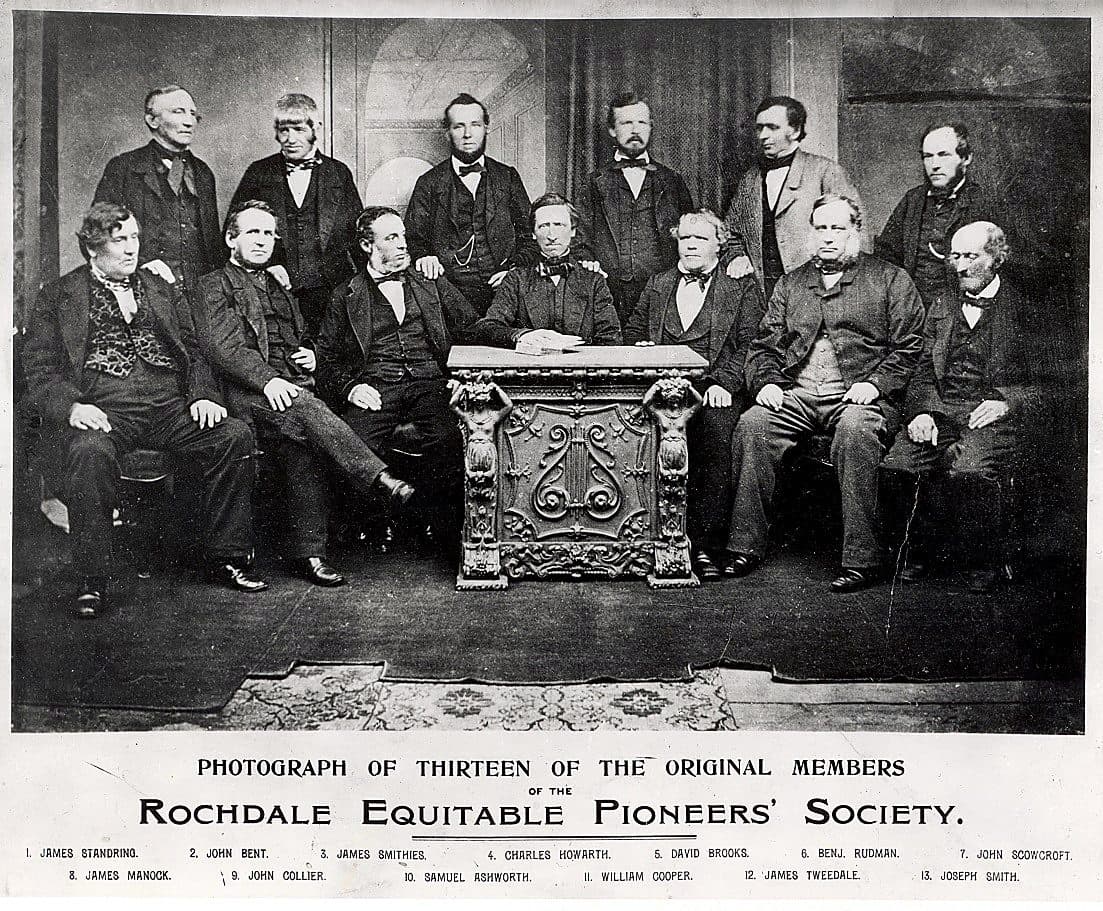
Before Rochdale: Mutual Aid and Early Experiments
The idea of people pooling resources for shared benefit is older than any formal economic system. Medieval guilds, village commons, and mutual aid societies all carried elements of what we now call cooperatives. But the deliberate creation of member-owned, democratically controlled enterprises — cooperatives as a distinct organisational form — began taking shape in the late 18th and early 19th centuries.
The Fenwick Weavers (1761) are among the earliest documented cooperative efforts. In Fenwick, Ayrshire, Scotland, a group of local weavers began buying oatmeal in bulk and selling it to members at a discount. They kept formal minutes and operated on democratic principles — each member had one vote, regardless of how much oatmeal they bought. The Fenwick Weavers Society survived for over a century and is now recognised by historians as a forerunner to the modern consumer cooperative.
Robert Owen (1771-1858), a Welsh textile manufacturer, is often called the father of the cooperative movement. Owen ran the New Lanark cotton mills in Scotland beginning in 1800 and demonstrated that treating workers well — shorter hours, decent housing, education for children — could coexist with commercial success. Owen went further: he proposed entire "Villages of Co-operation" where communities would collectively own the means of production. His 1824 experiment at New Harmony, Indiana failed within two years (disputes over governance and freeloading proved fatal), but his writings and lectures planted seeds across Britain. Owenite cooperative societies — small shops where workers could buy goods at fair prices — sprang up in the 1820s and 1830s. Most collapsed quickly. They lacked consistent rules for managing capital, distributing profits, and resolving disputes.
William King (1786-1865), a physician in Brighton, published The Co-operator from 1828 to 1830, a periodical that gave practical advice on running cooperative shops. King emphasised self-help rather than Owen's top-down model, and his writing influenced hundreds of small cooperative ventures across England. By 1830, there were an estimated 300 cooperative societies in Britain — but almost none survived beyond a few years. The missing ingredient was a durable set of operating rules.
The Rochdale Pioneers: 1844
On 21 December 1844, a group of 28 weavers and other tradespeople opened a small shop at 31 Toad Lane in Rochdale, Lancashire, England. They called themselves the Rochdale Society of Equitable Pioneers. Each member contributed one pound sterling to raise the initial capital of 28 pounds. The shop's first stock was modest: butter, sugar, flour, oatmeal, and a few candles.
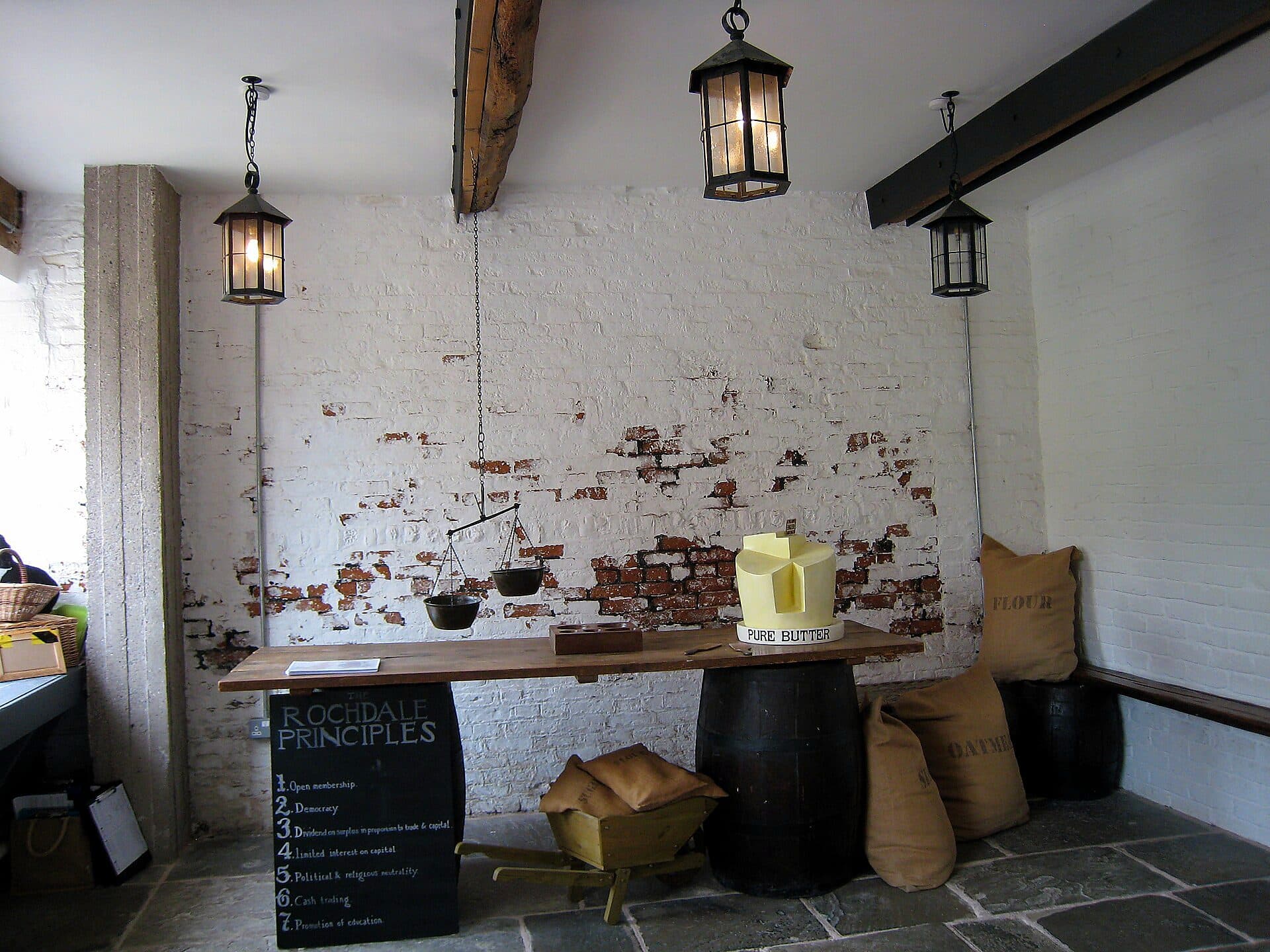
What made Rochdale different from the hundreds of cooperative shops that had failed before it was not the idea but the rules. The Pioneers codified a set of operating principles that solved the problems earlier cooperatives had stumbled on:
- Open membership — anyone could join, regardless of gender, religion, or political views
- Democratic control — one member, one vote
- Limited return on capital — investors received a fixed, modest interest rate, not unlimited profits
- Dividend on purchase — surplus was distributed to members in proportion to how much they bought, not how many shares they held
- Cash trading — no credit, which had destroyed earlier cooperative shops through bad debts
- Pure and unadulterated goods — in an era when food adulteration (chalk in flour, water in milk) was rampant, this was a genuine competitive advantage
- Education — a portion of surplus was set aside to educate members
These rules, later formalised as the Rochdale Principles, became the template for the entire global cooperative movement. The cooperative principles recognised by the International Cooperative Alliance today are direct descendants of the Rochdale framework.
The shop succeeded. Within a year, membership grew to 80. By 1855, the Rochdale Pioneers had 1,400 members and had expanded into a flour mill, a shoe factory, and a textile operation. By 1860, they were operating a wholesale supply chain. The model was replicable, and it replicated fast.
The building at 31 Toad Lane is now the Rochdale Pioneers Museum.
The 19th Century: Rapid Spread Across Europe
Britain and the Wholesale Movement
The success of Rochdale inspired a wave of consumer cooperatives across northern England and Scotland. By 1863, there were enough cooperative shops to justify a shared supply chain: the Co-operative Wholesale Society (CWS) was founded in Manchester to buy goods in bulk and distribute them to member societies. The CWS became one of the largest businesses in Britain, eventually manufacturing its own products, operating farms, and running shipping lines. The Scottish CWS followed in 1868.
The Co-operative Union (founded 1869) served as the movement's national federation, coordinating education, advocacy, and standardisation of rules. By 1900, Britain had over 1,400 cooperative societies with 1.7 million members.
Germany: Credit Cooperatives
While British cooperatives focused on consumer goods, Germany produced a parallel innovation: cooperative banking.
Hermann Schulze-Delitzsch (1808-1883) founded the first credit cooperative for urban artisans and tradespeople in 1850. His model — members pooled savings and lent to each other at fair rates — gave small businesspeople access to credit that conventional banks refused them.
Friedrich Wilhelm Raiffeisen (1818-1888) adapted the credit cooperative model for rural communities. His first cooperative savings bank was established in Anhausen in 1862. Raiffeisen cooperatives were smaller and more tightly knit than Schulze-Delitzsch's — they served a single village, required character references for loans, and operated on a philosophy of mutual self-help rooted in Christian social teaching. By Raiffeisen's death in 1888, there were 425 Raiffeisen cooperatives in Germany.
The Raiffeisen model spread across continental Europe and eventually worldwide. It is the direct ancestor of modern credit unions.
France and Italy
In France, Charles Gide (1847-1932), an economist at the University of Montpellier, championed the "Nimes School" of cooperativism, arguing that consumer cooperatives could gradually replace capitalism by expanding into production. The French consumer cooperative movement grew steadily, though it never achieved the dominance of its British counterpart.
Italy developed a strong tradition of worker cooperatives, particularly in the Emilia-Romagna region. Worker cooperatives in construction, agriculture, and manufacturing became a defining feature of the Italian economy — a tradition that persists today.
North America: Agricultural Cooperatives
In the United States, farmers were the primary drivers of early cooperative development. The Grange movement (formally the National Grange of the Order of Patrons of Husbandry, founded 1867) organised farmers into local chapters that operated cooperative grain elevators, stores, and insurance companies. By 1875, the Grange had 858,000 members across 32 states.
The Farmers' Alliance movement of the 1880s and 1890s pushed further, establishing cooperative cotton gins, warehouses, and marketing organisations across the South and Great Plains. Many of these early agricultural cooperatives failed due to undercapitalisation and opposition from established grain traders — but they proved that farmers understood the cooperative model and wanted it. Read more about how US agricultural cooperatives evolved in our guide to cooperatives in the United States.
In Canada, Alphonse Desjardins (1854-1920) founded the first caisse populaire (credit union) in Levis, Quebec in 1900, modelled on the Raiffeisen system. Desjardins cooperatives spread rapidly across francophone Canada and became one of the largest financial cooperative networks in North America. The Desjardins Group today has over 7 million members and $400 billion in assets.
The International Cooperative Alliance: 1895
The cooperative movements of different countries recognised early that coordination across borders mattered. In August 1895, delegates from cooperatives in Britain, France, Germany, Italy, Belgium, the Netherlands, Switzerland, Serbia, Argentina, Australia, India, and the United States met in London to found the International Cooperative Alliance (ICA).
The ICA's founding purpose was to define and defend cooperative identity, facilitate information exchange between national movements, and represent cooperatives in international forums. It adopted the Rochdale Principles as the standard definition of a cooperative — a definition it has updated (most recently in 1995) but never abandoned.
The ICA is the oldest and largest non-governmental organisation representing cooperatives. It currently has member organisations in over 100 countries.
The 20th Century: Cooperatives Go Mainstream
Rural Electrification in the United States
Perhaps the most dramatic cooperative success story of the 20th century unfolded across rural America. In 1935, less than 11% of American farms had electricity. Private utilities refused to extend power lines to sparsely populated areas — the economics didn't work for investor-owned companies seeking maximum return on capital.
The Rural Electrification Act of 1936, signed by President Franklin D. Roosevelt, created the Rural Electrification Administration (REA) and authorised low-interest federal loans to cooperative organisations willing to build and operate rural electric grids. The programme's legacy is documented by the USDA Rural Development, which succeeded the REA as the federal cooperative finance authority. Farmers formed electric cooperatives at a staggering pace: within a decade, hundreds of cooperatives were stringing power lines across the American countryside.
By 1953, over 90% of American farms had electricity. Today, roughly 900 electric cooperatives serve 42 million Americans across 56% of the nation's landmass. They are among the most visible and durable types of cooperatives in the United States.
The Credit Union Movement
The credit union model — a cooperative financial institution owned by its depositors — expanded dramatically in the 20th century. In the United States, the Federal Credit Union Act of 1934 established a federal charter system for credit unions, providing regulatory stability. Edward Filene, a Boston department store owner, and Roy Bergengren, a lawyer, were instrumental in building the American credit union movement through the Credit Union National Extension Bureau (later the Credit Union National Association, CUNA).
By mid-century, credit unions were a standard feature of American financial life, particularly among workplace groups, churches, and community organisations. The global credit union movement now encompasses 67,137 credit unions in 101 countries, serving 412.7 million members (WOCCU, end of 2024).
Mondragon: The Worker Cooperative as Industrial Power
In 1956, five young graduates of a technical college in the Basque town of Mondragon, Spain, founded a small cooperative factory making paraffin heaters. Their teacher, Father Jose Maria Arizmendiarrieta (1915-1976), a Catholic priest, had spent the previous 15 years building a network of schools, a polytechnic, and a cooperative credit union in Mondragon — the infrastructure that would support what became the world's largest worker cooperative federation.
The Mondragon Corporation grew from that single factory into a network of over 250 cooperatives spanning manufacturing, retail, finance, and education. At its peak, it employed over 80,000 worker-owners. Mondragon's internal structures — wage ratios capped between highest and lowest paid, worker assemblies electing management, an inter-cooperative solidarity fund — demonstrated that democratic ownership could operate at industrial scale.
Mondragon has faced challenges (the 2013 bankruptcy of Fagor Electrodomesticos, its largest industrial cooperative, was a significant setback), but it remains the most cited proof-of-concept for large-scale worker ownership. Its influence on the global worker cooperatives movement is immeasurable.
Post-War Global Spread
After World War II, cooperatives became a deliberate tool of development policy. Newly independent nations in Africa and Asia established agricultural cooperatives, often with government support (and sometimes government control that undermined genuine member ownership). The results were mixed:
- India built one of the world's largest cooperative networks. The Amul dairy cooperative in Gujarat (founded 1946) pioneered the cooperative dairy model that now processes 26 million litres of milk daily across the country. India's sugar cooperatives, housing cooperatives, and credit cooperatives collectively serve hundreds of millions of members.
- Kenya developed a strong coffee and tea cooperative sector. The Kenya Co-operative Creameries and coffee cooperative unions became major economic actors.
- Scandinavian countries deepened their already strong cooperative traditions. Danish and Swedish agricultural cooperatives controlled substantial shares of dairy, meat, and grain markets. In Sweden, the cooperative housing sector (HSB and Riksbyggen) built much of the post-war housing stock.
- Japan established agricultural cooperatives (JA Group) that became the backbone of rural Japan, providing credit, insurance, marketing, and supply services to virtually every farming household.
Where governments imposed cooperatives from above — as in many Soviet-aligned countries and some post-colonial states — the results were often poor. Top-down cooperatives without genuine member control are cooperatives in name only.
Timeline: Key Dates in Cooperative History
| Year | Event |
|---|---|
| 1761 | Fenwick Weavers Society founded in Scotland |
| 1800 | Robert Owen takes over New Lanark mills |
| 1828 | William King publishes The Co-operator |
| 1844 | Rochdale Society of Equitable Pioneers opens at 31 Toad Lane |
| 1850 | Schulze-Delitzsch founds first German credit cooperative |
| 1862 | Raiffeisen establishes cooperative savings bank in Anhausen |
| 1863 | Co-operative Wholesale Society (CWS) founded in Manchester |
| 1867 | National Grange founded in the United States |
| 1895 | International Cooperative Alliance (ICA) founded in London |
| 1900 | Alphonse Desjardins founds first caisse populaire in Quebec |
| 1934 | U.S. Federal Credit Union Act signed into law |
| 1936 | Rural Electrification Act creates framework for electric co-ops |
| 1946 | Amul dairy cooperative founded in Gujarat, India |
| 1956 | First Mondragon cooperative factory opens in Spain |
| 1966 | ICA adopts revised cooperative principles |
| 1995 | ICA issues Statement on the Cooperative Identity (current principles) |
| 2012 | United Nations declares International Year of Cooperatives |
| 2016 | Stocksy United launches as a platform cooperative for photographers |
| 2020 | Driver cooperatives emerge as alternatives to gig economy platforms |
The Modern Era: Platform Cooperatives and New Frontiers
Platform Cooperativism
The rise of the gig economy — Uber, DoorDash, Instacart, and similar platforms — created a new class of workers with no ownership stake, no benefits, and no voice in the platforms they depend on. Beginning around 2014, scholars and activists (notably Trebor Scholz at The New School in New York) began articulating the concept of platform cooperativism: digital platforms owned and governed by the people who use them.
Learn more about these digital models in our guide to platform cooperatives. Platform cooperatives now operate across multiple sectors:
- Stocksy United (2012) — a photographer-owned stock photography cooperative based in Victoria, British Columbia. Photographers earn 50-75% of each sale, compared to the 15-20% typical at conventional stock agencies.
- The Drivers Cooperative (2020) — a driver-owned ride-hailing cooperative in New York City. Drivers keep a larger share of fares and elect the board of directors.
- Up & Go (2017) — a platform connecting customers with worker-owned cleaning cooperatives in New York City. The cleaners own the platform and set their own rates.
- Resonate — a cooperative music streaming service where artists and listeners share ownership.
Platform cooperativism is still small relative to venture-backed platforms, but it offers a structural alternative: technology owned by the people who create value through it.
Freelancer and Gig Worker Cooperatives
Beyond platforms, freelancers and independent workers are forming cooperatives to share back-office costs, negotiate contracts collectively, and provide mutual insurance. Smart (Societe Mutuelle pour Artistes), founded in Belgium in 1998, now operates across nine European countries, providing 120,000 freelance workers with invoicing, insurance, and collective bargaining services through a cooperative structure.
In the United States, home care workers — one of the fastest-growing and lowest-paid occupations — have formed cooperatives like Cooperative Home Care Associates (CHCA) in the Bronx, New York (founded 1985, over 2,000 worker-owners), and inspired dozens of similar cooperatives across the country.
Cooperatives in the Green Transition
Renewable energy cooperatives have grown rapidly in Europe. In Germany alone, over 800 Energiegenossenschaften (energy cooperatives) have been established, collectively owning wind turbines, solar arrays, and community heating systems. Denmark's wind energy sector was largely built by cooperatives in the 1980s and 1990s — at one point, roughly 100,000 Danish families were members of wind cooperatives.
Community-owned renewable energy gives members both a financial return and a democratic say in local energy planning — a direct parallel to the American rural electrification movement of the 1930s.
Cooperatives Today: Scale and Scope
The cooperative model is far from a historical curiosity. According to the ICA and its research arm, the World Cooperative Monitor:
- Over 3 million cooperatives operate worldwide
- The top 300 cooperatives generate $2.1 trillion in annual turnover
- Cooperatives provide employment or work for approximately 280 million people — about 10% of the world's employed population
- Cooperative membership exceeds 1 billion people globally
The largest cooperatives by revenue include agricultural giants (Zen-Noh and NH Foods in Japan, Bay WA in Germany, CHS Inc. in the United States), financial cooperatives (Credit Agricole in France, Rabobank in the Netherlands, Desjardins in Canada), and consumer cooperatives (Migros and Coop in Switzerland, The Co-operative Group in the UK).
The cooperative model operates across virtually every sector of the economy. Understanding both the advantages and disadvantages of the cooperative structure helps explain why this model has endured for nearly two centuries while many alternative economic experiments have not.
Frequently Asked Questions
Who started the first cooperative?
The Rochdale Society of Equitable Pioneers (1844) is widely recognised as the first successful modern cooperative because of its codified operating principles. However, earlier experiments existed — notably the Fenwick Weavers Society in Scotland (1761) and various Owenite cooperative shops in England during the 1820s and 1830s. The Rochdale Pioneers were the first to create a replicable model that survived.
What were the Rochdale Principles?
The original Rochdale Principles included: open membership, democratic control (one member, one vote), limited return on capital, dividend on purchase (surplus shared by patronage), cash trading, sale of pure goods, and provision for education. These principles have been updated over time; the current version, adopted by the International Cooperative Alliance in 1995, defines seven cooperative principles.
When did cooperatives come to the United States?
Cooperative activity in the United States dates to the mid-19th century, with the Grange movement (1867) organising farmers into cooperative grain elevators and stores. Credit unions arrived in 1909 (the first federally recognised credit union was in New Hampshire). The major expansion came during the New Deal: the Rural Electrification Act of 1936 spawned hundreds of electric cooperatives that still serve rural communities today.
What is the largest cooperative in the world?
By membership, the largest cooperatives are national federations like the Indian Farmers Fertiliser Cooperative (IFFCO) with over 35,000 member societies representing 50 million farmers. By revenue, Credit Agricole (France), a cooperative banking group, and Zen-Noh (Japan), an agricultural cooperative federation, are among the largest. The Mondragon Corporation in Spain is the largest federation of worker cooperatives.
Are cooperatives still relevant today?
Cooperatives employ or provide work for 280 million people worldwide — more than all multinational corporations combined. The model is actively expanding into new sectors including renewable energy, digital platforms, housing, and healthcare. Platform cooperatives offer a worker-owned alternative to gig economy platforms, and community energy cooperatives are central to the green transition in Europe. The cooperative form is not a relic; it is adapting to 21st-century challenges.
Explore Further
- What are Cooperatives? — definitions, structure, and how cooperatives work
- Types of Cooperatives — consumer, worker, producer, housing, and more
- Cooperative Principles — the seven principles that define cooperative identity
- Agricultural Cooperatives — how farmers use the cooperative model
- Electric Cooperatives — the rural electrification story and modern electric co-ops
- Worker Cooperatives — from Mondragon to modern worker ownership
- Advantages and Disadvantages — honest assessment of the cooperative model
- Cooperative Governance → — how cooperatives are managed and controlled
- Browse the cooperative directory →


References & further reading
This guide is researched against primary sources. Where we cite figures, they reflect the most recent data published by these organisations at the time of writing.
- 1.Cooperative identity, values & principles — International Cooperative Alliance
- 2.The 7 Cooperative Principles — NCBA CLUSA
Continue Reading
Find Cooperatives Worldwide
Browse 26,000+ cooperatives by sector and country in our free directory.