Colombia has one of Latin America's most developed and diverse cooperative sectors, with over 3,500 registered cooperatives serving approximately 5 million members. The country's cooperative movement spans healthcare, financial services, dairy, coffee, and worker-owned enterprises, and its apex institution — the Federación Nacional de Cafeteros (FNC) — is one of the world's most effective agricultural producer organisations, the body behind the Juan Valdez brand that has become globally synonymous with Colombian coffee. Colombian cooperatives contribute an estimated 5–6% of GDP and employ over 160,000 people directly. The cooperative movement's depth reflects decades of civil society development alongside — and partly in response to — the country's turbulent political history.
Cooperative Sector Overview
Colombia's cooperative sector is unusual in Latin America for its strength across multiple economic sectors simultaneously. Health cooperatives (Coomeva, Coosalud) operate as significant health service providers. Financial cooperatives (Confecoop, credit unions, Bancoomeva) serve millions of members who lack access to commercial banking. The dairy cooperative Colanta is one of Colombia's largest food companies. And the FNC's 540,000 coffee farming families have used cooperative principles to build a globally recognised brand.
| Metric | Figure |
|---|---|
| Registered cooperatives | 3,500+ |
| Total members | ~5 million |
| Direct employment | 160,000+ |
| GDP contribution | ~5–6% |
| Primary legislation | Ley 79 de 1988 (Cooperative Law 1988) |
| Regulator | Supersolidaria (Superintendencia de Economía Solidaria) |
| Apex body | Confecoop (Confederación de Cooperativas de Colombia) |
| Coffee farmer cooperative members | 540,000 (FNC) |
The cooperative movement in Colombia has historical roots in Catholic social teaching — specifically the 1891 encyclical Rerum Novarum — and was formalised through labour movement organisations in the early twentieth century. The first Colombian cooperative law was passed in 1931. Significant growth came in the 1960s and 1970s under government promotion programmes that saw cooperatives as a third path between state socialism and private capitalism.
Key Cooperative Sectors
Coffee: Federación Nacional de Cafeteros and Juan Valdez
The Federación Nacional de Cafeteros de Colombia (FNC) is not technically a cooperative but a non-profit private organisation governed by coffee-growing families, operating under principles functionally similar to cooperative governance. Founded in 1927, the FNC represents approximately 540,000 coffee farming families — about 95% of Colombian coffee growers — and manages the certification, marketing, and branding of Colombian coffee globally.
The Juan Valdez trademark and the fictional muleteer character are managed by the FNC as a country-of-origin brand guarantee. This marketing cooperative model — farmer-governed organisations controlling a premium brand — has proven highly effective at capturing value chain margins for producers. Colombian coffee exported under the Juan Valdez certification must meet FNC quality standards. This model — a farmer-governed organisation managing a premium brand rather than selling a commodity — has kept Colombian coffee prices significantly above Brazilian and Vietnamese coffee for decades.
Almacafé, the FNC's commercial subsidiary, handles physical coffee logistics: warehousing, dry milling, quality inspection, and export. The Fondo Nacional del Café is a national coffee price stabilisation fund managed by the FNC under a public contract.
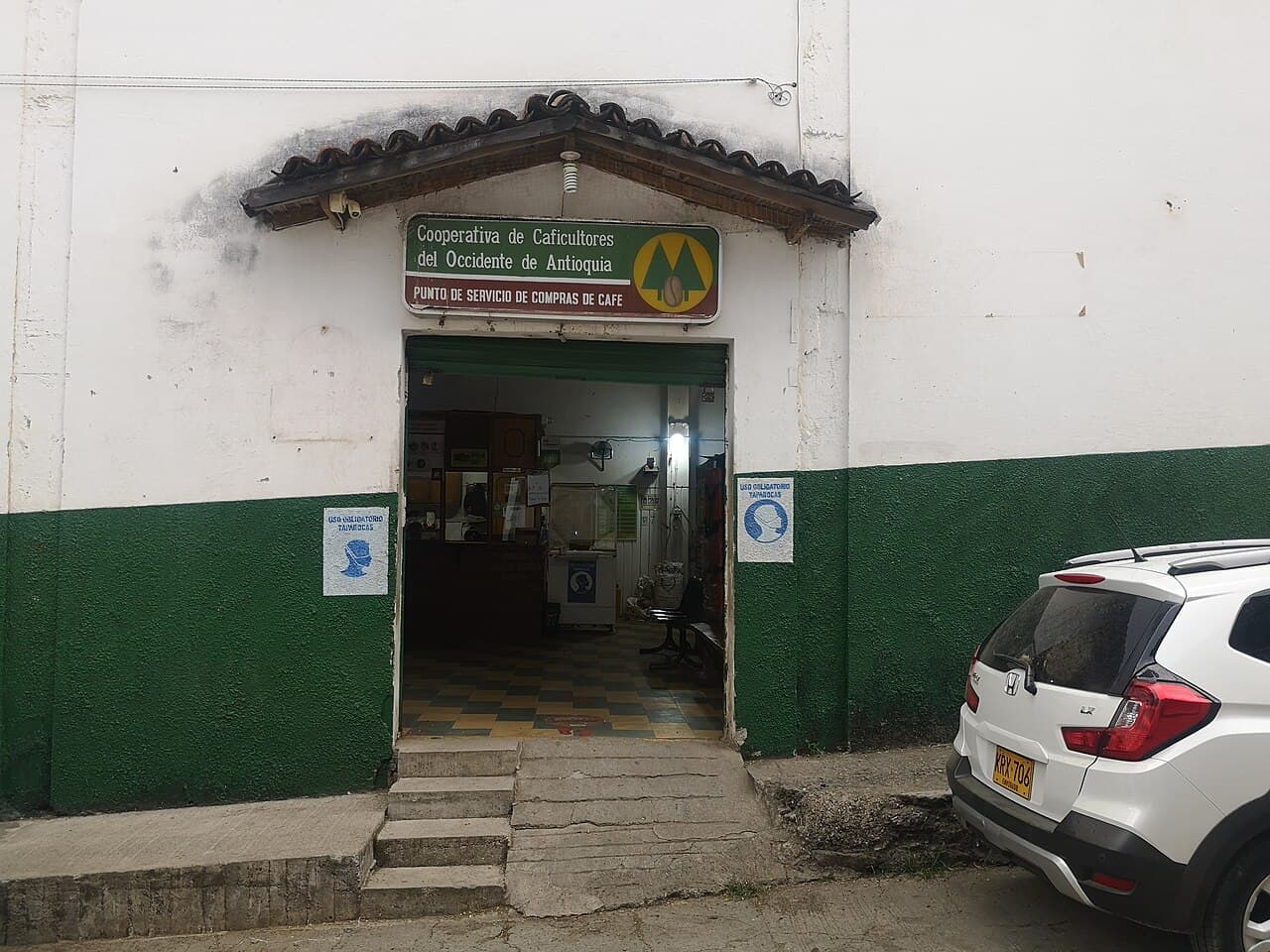
Primary coffee cooperatives at the municipal level — such as Cooperativa de Caficultores de Antioquia (covering Antioquia department's 50,000 coffee families) and Cooperativa de Caficultores de Manizales — are federated under the FNC structure. These primary cooperatives provide collection points, wet milling, technical assistance, and member credit.
Health Cooperatives
Colombia's healthcare system includes a significant cooperative segment. Coomeva Cooperativa is Colombia's largest multi-purpose cooperative and one of Latin America's largest, with over 260,000 members across multiple service areas. Its health division, Coomeva EPS (Entidad Promotora de Salud), was one of Colombia's largest health insurance entities, though it faced severe financial difficulties in the 2020s that led to government intervention.
Coosalud is a healthcare cooperative focused on community health in the Caribbean coast region (Sucre, Córdoba, Bolívar departments), providing managed care to social security beneficiaries in underserved communities. SaludCoop was historically Colombia's largest health cooperative but collapsed in 2015 following revelations of massive mismanagement and inappropriate capital diversion — a major scandal that prompted regulatory reform.
Financial Cooperatives
Solidarios (formerly Cooperativa Nacional de Ahorro y Crédito) and dozens of credit cooperatives provide financial services across Colombia. JEP Ahorro y Crédito and regional credit cooperatives serve millions of members in mid-sized cities and rural areas.
Bancoomeva, the banking subsidiary of Coomeva, is a full commercial bank that grew from the cooperative's financial services operations. It holds a commercial banking license and serves both cooperative members and the general public, operating in a regulatory grey zone between cooperative principles and commercial banking operations.
Dairy: Colanta
Colanta (Cooperativa Lechera de Antioquia) is Colombia's largest dairy cooperative and one of the country's most significant food companies, with revenues exceeding COP 2.5 trillion annually. Founded in 1964 in Don Matías, Antioquia, Colanta grew from a small dairy collection cooperative into a national dairy processor with operations across multiple departments.
Colanta processes and markets fresh milk, UHT milk, cheese, butter, yoghurt, and meat (it also has a meat processing division). Its brands are dominant in the Antioquia, Bogotá, and national markets. Colanta has approximately 10,000 dairy and meat farmer-members and serves them with artificial insemination services, veterinary support, and quality management.
What makes Colanta particularly notable is that it grew into a major corporation while maintaining genuine cooperative governance and member service orientation — a contrast to the governance failures at SaludCoop and Coomeva EPS.
Worker Cooperatives
Colombia has a significant worker cooperative sector, but also a problematic history of Cooperativas de Trabajo Asociado (CTA) — work-associated cooperatives — being used to circumvent labour protections. In the early 2000s, many Colombian companies converted workers to CTA membership to avoid paying minimum wage, social security, and severance benefits. At peak, there were over 500,000 Colombians formally classified as cooperative members working under what were effectively precarious labour arrangements.
The 2010 Ley 1233 and subsequent reforms sought to end this abuse, requiring genuine cooperative labour relations and prohibiting CTAs from serving as intermediaries for what are effectively employment relationships. Genuine worker cooperatives — where worker-members own and govern the enterprise — continue to operate in sectors like media, healthcare, and professional services.
Legal Framework
Ley 79 de 1988 (Cooperative Law)
The primary cooperative legislation is Ley 79 de 1988, which defines cooperatives and establishes governance requirements. Key provisions include:
- Minimum 20 founding members for a cooperative
- Democratic governance: one member, one vote
- Mandatory governance bodies: General Assembly, Board of Directors (Consejo de Administración), Management Oversight Board (Junta de Vigilancia)
- Surplus distribution based on member participation (patronage principle)
- Non-distributable reserves: 20% of surplus to a protection fund; 20% to cooperative development fund
- Education fund allocation mandatory
Ley 454 de 1998 — Social and Solidarity Economy
Ley 454 de 1998 expanded the framework for the economía solidaria — the solidarity economy — of which cooperatives are the largest component. This law created the regulatory framework for mutual savings associations, solidarity enterprises, and associated work cooperatives alongside conventional cooperatives.
Supersolidaria
The Superintendencia de la Economía Solidaria (Supersolidaria) is the national regulator for the cooperative and solidarity economy sector. It has supervisory and sanctioning powers over cooperatives, including authority to intervene in financially distressed cooperatives. The SaludCoop collapse and Coomeva EPS difficulties demonstrated both the importance of effective regulation and the risks of delayed intervention.
Ley 1233 de 2008 — CTA Reform
This law established that Cooperativas de Trabajo Asociado must operate under genuine cooperative principles. Members must share governance and economic risk; CTAs may not act as labour supply agencies for external employers. Implementation required cooperatives to restructure relationships with third-party clients and led to a significant reduction in the CTA sector's size.
Major Cooperatives
Coomeva Cooperativa
Founded: 1964 Members: 260,000+ Sector: Multi-service (health, financial, recreation, professional)
Coomeva was founded by medical professionals in Cali as a mutual self-help cooperative for doctors and healthcare workers. It grew over decades into Colombia's largest cooperative by member count, expanding into health insurance, financial services, recreation, and professional development. Coomeva EPS, its health insurance subsidiary, served over 3 million health plan holders. Financial difficulties in Coomeva EPS led to government-supervised restructuring from 2022 onwards.
Colanta
Founded: 1964 Members: ~10,000 farmer-members Revenue: COP 2.5+ trillion Sector: Dairy and meat processing
Colanta is Colombia's most successful agricultural cooperative by revenue and the standard reference for how a cooperative can achieve national market leadership. It operates processing plants in Antioquia, Córdoba, Caldas, and Bogotá. Its consumer brands (Colanta fresh milk, Colanta cheese, Algarra) have become household names. The cooperative's growth is attributed to disciplined governance under long-serving general manager Jenaro Pérez Gutiérrez (in the role for decades) and a consistent member-service philosophy.
Cooperativa de Caficultores de Antioquia
Founded: 1946 Members: ~50,000 coffee farming families Sector: Coffee (washing, drying, export)
One of Colombia's largest primary coffee cooperatives, operating under FNC federation structures across Antioquia department. It provides wet milling facilities, quality certifications, and member credit. It exports direct trade specialty coffee as well as FNC-certified commodity coffee.
Cooperativa Multiactiva de Empleados del Sector Salud (Coosalud)
Founded: 1993 Members: ~200,000 health plan affiliates Sector: Health managed care (Caribbean coast)
Coosalud provides managed healthcare to Social Security (SGSSS) beneficiaries in poor communities in the Caribbean coast region. Its cooperative structure aligns incentives differently from profit-oriented health insurers: serving member health well is both a governance obligation and the core business model. Coosalud is regarded as a well-governed health cooperative in contrast to the SaludCoop failure.
SaludCoop (Historical)
Founded: 1994 — Intervened: 2015 Noted here because its history is instructive. SaludCoop grew rapidly to become Colombia's largest health cooperative with 4.5 million health plan members, but its leadership diverted billions of pesos of health funds into personal investments, real estate, and related companies. The Supersolidaria and government intervened in 2015. The case led to significant regulatory reform and is studied extensively in Latin American cooperative governance literature.
Challenges and Opportunities
Post-SaludCoop Trust Deficit
The SaludCoop collapse created a lasting trust deficit for health cooperatives in Colombia. Regulators have increased intervention powers and financial reporting requirements for large cooperatives. Coomeva EPS's difficulties compounded the perception that large cooperative health insurers are governance-prone. Rebuilding public and regulatory confidence is an ongoing challenge.
CTA Sector Legacy
The abuse of work-associated cooperatives created significant negative associations for the cooperative label in Colombia. Some employers and workers have avoided cooperative structures due to the association with precarious employment. Distinguishing genuine worker cooperatives from the former CTAs is an advocacy challenge for Confecoop and genuine cooperative organisations.
Rural Coffee Cooperative Development
While the FNC provides strong national-level representation, primary coffee cooperatives in Colombia's conflict-affected regions (Cauca, Nariño, Caquetá) have struggled with security issues, forced displacement, and post-peace-accord reintegration. Supporting cooperative development in historically marginalised coffee regions offers economic inclusion potential, with several NGO and USAID programmes working on this.
Health Cooperative Restructuring
The difficulties at Coomeva EPS and other large health cooperatives create an opportunity for restructuring toward smaller, genuinely member-governed health cooperatives. Colombia's health system reforms provide a potential context for new cooperative health models that avoid the scale-and-governance problems of the large EPSs.
Related Articles
References & further reading
This guide is researched against primary sources. Where we cite figures, they reflect the most recent data published by these organisations at the time of writing.
- 1.Facts & figures on the cooperative movement — International Cooperative Alliance
- 2.Cooperatives and the world of work — International Labour Organization
Find Cooperatives Worldwide
Browse 26,000+ cooperatives by sector and country in our free directory.