Well-known examples of cooperatives include CHS, Dairy Farmers of America and Land O'Lakes (farmer-owned), Navy Federal Credit Union and State Employees' Credit Union in North Carolina (member-owned financial co-ops), Wakefern, Associated Wholesale Grocers and Ace Hardware (owned by the independent stores they supply), Park Slope Food Coop and Willy Street Co-op (owned by shoppers), Cobb EMC (an electric co-op) and Equal Exchange (a worker-owned co-op).
A cooperative is a business owned and run by the people who use it, whether as customers, farmers, workers or independent businesses. This page gives examples of each type, with facts from the co-op's own pages and the NCB Co-op 100, the annual ranking of America's top 100 cooperatives by revenue. Each section points to a longer guide. For the top 25 in one table, see largest cooperatives in the US.
Farmer-owned cooperatives
In a farm co-op the farmers own the business that processes and sells what they grow or produce. In the NCB Co-op 100, agriculture is the biggest group: 48 of the 100 co-ops, with 52.1% of the 100's combined revenue.
| Example | State | 2024 revenue (NCB) |
|---|---|---|
| CHS Inc. | MN | $39,261 million |
| Dairy Farmers of America | KS | $23,016 million |
| Land O'Lakes, Inc. | MN | $16,207 million |
| GROWMARK, Inc. | IL | $12,205 million |
| Ocean Spray | MA | $2,041 million |
| Organic Valley (CROPP) | WI | $1,204 million |
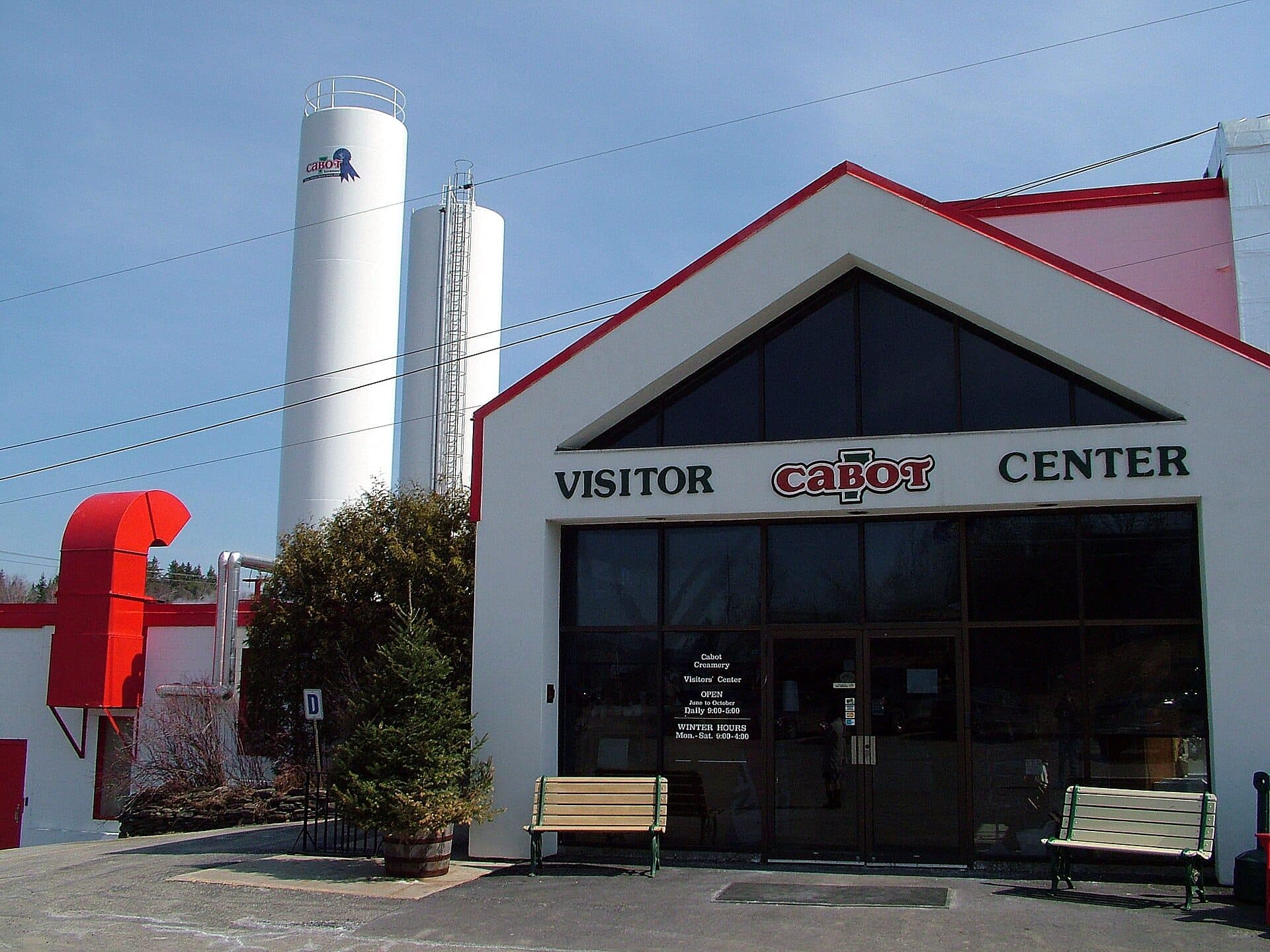
Source: NCB Co-op 100 Report (2025). Another example NCB profiles is Agri-Mark, which it describes as "a dairy cooperative and certified B-Corp owned by hundreds of farm families throughout New England and Upstate New York," whose farmers' milk becomes Cabot Creamery cheddar and other products.
More: agricultural cooperative examples, brands that are cooperatives and top agricultural cooperatives in the United States.
Credit unions and other financial cooperatives
A credit union is a not-for-profit financial institution owned by its members. MyCreditUnion.gov says "credit unions are owned and controlled by their members" and run by a member-elected volunteer board.
| Example | State | Assets and members (NCUA, June 30, 2026) |
|---|---|---|
| Navy Federal Credit Union | VA | $204.4 billion, 15,517,448 members |
| State Employees' Credit Union | NC | $60.0 billion, 2,998,339 members |
| SchoolsFirst Federal Credit Union | CA | $37.2 billion, 1,579,561 members |
Source: NCUA 5300 Call Report quarterly data for June 30, 2026. The NCUA register lists State Employees' Credit Union as "State Employees'" and SchoolsFirst as "SCHOOLSFIRST."
Farm lenders such as CoBank and AgriBank also appear in the Co-op 100 under Finance. See largest credit unions in the US, credit cooperatives, banking cooperatives and credit unions anyone can join.
Retailer-owned buying groups
These co-ops are owned by independent stores, which pool their buying to compete with larger chains.
- Ace Hardware was "founded in 1924 by a small group of Chicago hardware store owners," according to NCB's profile. NCB says Ace store owners are shareholders and "don't pay franchise or royalty fees."
- Wakefern Food Corp., whose member companies operate stores under banners including ShopRite, "began in 1946 as a small, local cooperative formed by eight visionary grocery store owners," says NCB, which calls it "the largest retailer-owned cooperative in the United States."
- Associated Wholesale Grocers and Do-it-Best Corp. are ranked 9th and 14th on the NCB list, with $12,094 million and $4,598 million in 2024 revenue.
See purchasing cooperatives for how these groups work.
Consumer and food cooperatives
In a food co-op, the shoppers own the store.
- Park Slope Food Coop (Brooklyn, New York) has a working membership: all members work a 2 hour 45 minute shift each work cycle unless exempt. A new member pays a $25 joining fee and a $100 refundable investment, according to its member manual.
- Willy Street Co-op (Madison, Wisconsin) sells to everyone and gives owners extra benefits. An individual ownership is $56 and a household ownership is $91, according to its site.
- National Co+op Grocers is a business services cooperative that says it represents 169 food co-ops operating 241 stores in 40 states.
- REI (Recreational Equipment Inc.) is number 17 on the Co-op 100, with $3,536 million in 2024 revenue.
See food cooperatives and how to start a food buying club.
Electric cooperatives
Electric co-ops are owned by the customers they serve. NCB's report describes Cobb EMC as a "not-for-profit, member-owned electric cooperative" serving "nearly 200,000 residential and commercial consumers" in five counties, ranked 39th with $1,700 million in 2024 revenue. Basin Electric Power Cooperative (North Dakota, $2,817 million) is number 21.
Worker-owned cooperatives
In a worker co-op the employees own the business.
- Equal Exchange is described by the Food Co-op Initiative as "a for-profit Fairtrade, worker-owned cooperative" that distributes organic coffee, tea, sugar, bananas, avocados, nuts, dried fruit, cocoa and chocolate produced by farmer cooperatives in Latin America, Africa and Asia.
- The U.S. Federation of Worker Cooperatives (Chicago) is described in NCB's report as "the only national membership organization focused on advancing economic opportunities through cooperative worker ownership." NCB lists it among its 2025 Co-op Innovation Award recipients.
See worker cooperative examples and worker cooperatives.
Housing cooperatives
In a housing co-op, residents own the building together. NCB's report describes the Nashville Equitable Housing Collaborative in Tennessee, which "developed its first 60-unit limited-equity affordable housing cooperative" in 2024, and says it received a $50,000 grant in NCB's 2025 awards.
See housing cooperatives.
Healthcare cooperatives
NCB's list includes one healthcare co-op: HealthPartners Inc. of Minnesota, number 11 with $9,032 million in 2024 revenue. See health cooperatives.
How to tell whether a business is a cooperative
NCB's Co-op 100 report defines a cooperative as "a business organized, owned and controlled by the people who use its products and services." It says that "co-ops are an everyday part of American life," and that you may meet one "at the credit union where you bank" or "in the brand names in your grocery store aisles." The report also says "1 in 3 Americans are a member of a co-op," a claim we did not check against a second source.
Three questions help when you are not sure:
- Who owns it? In a co-op, the owners are the people who use it: farmers, shoppers, members, workers or independent businesses.
- Who votes? Members elect the board, usually one member one vote. A shareholder company votes by shares.
- Where does the surplus go? Co-ops return surplus to members or keep it in the business, as members decide. See patronage refunds for how that works.
A brand name alone does not settle it. Some firms call their paid membership a "club" and charge a fee, but the Food Co-op Initiative notes that for such companies "the users or members have no real stake in the business." Check the ownership and voting, not the label.
What the examples have in common
Each example is owned by the people who use it. The Co-op 100 report lists the seven cooperative principles as: voluntary and open membership, democratic member control, member economic participation, autonomy and independence, education, training and information, cooperation among cooperatives, and concern for community. Read cooperative principles for what each means.
What changes from one type to the next is who the owners are:
| Type | Who owns it |
|---|---|
| Farmer-owned | Farmers or farm families |
| Credit union | Members who save and borrow |
| Retailer-owned | Independent stores |
| Food co-op | Shoppers |
| Electric co-op | Customers served |
| Worker co-op | Employees |
| Housing co-op | Residents |
Frequently Asked Questions
What are some examples of cooperatives?
CHS, Dairy Farmers of America, Land O'Lakes, Navy Federal Credit Union, Wakefern (ShopRite), Ace Hardware, Park Slope Food Coop, Cobb EMC and Equal Exchange. Each is described in the sections above with a source.
What is the largest cooperative in the US?
By 2024 revenue in the NCB Co-op 100, the largest is CHS Inc. See largest cooperatives in the US.
Is a credit union a cooperative?
Yes. A credit union is a member-owned financial cooperative. MyCreditUnion.gov says credit unions are "owned and controlled by their members."
Are there cooperatives I might use without knowing it?
Several of the examples sell under brand names: Land O'Lakes, Ocean Spray and Cabot appear in NCB's list or profiles. See brands that are cooperatives.
What is the difference between a cooperative and a regular company?
A co-op is owned by the people who use it, and each member usually has one vote. A regular company is owned by shareholders. See cooperative vs LLC and what are cooperatives.
What are examples of worker cooperatives?
Equal Exchange is one US example. For international examples, see Mondragon Corporation and worker cooperative examples.
Where to go next
- Largest Cooperatives in the US: the top 25 by revenue
- Cooperative Examples Around the World: twelve co-ops in other countries
- Types of Cooperatives: the main models
- What Are Cooperatives?: the basics
- Cooperative Principles: the seven principles
References & further reading
- 1.NCB Co-op 100 Report 2025 (2024 data) — National Cooperative Bank
- 2.What is a Credit Union? — MyCreditUnion.gov (NCUA)
- 3.Buying Clubs & Online Markets (FCI Action Guide, 2022) — Food Co-op Initiative
- 4.Membership Manual — Park Slope Food Coop
- 5.Co-op Ownership — Willy Street Co-op
- 6.About Us — National Co+op Grocers
- 7.5300 Call Report quarterly data, June 30, 2026 — National Credit Union Administration
Find Cooperatives Worldwide
Browse cooperatives by sector and country in our free directory.